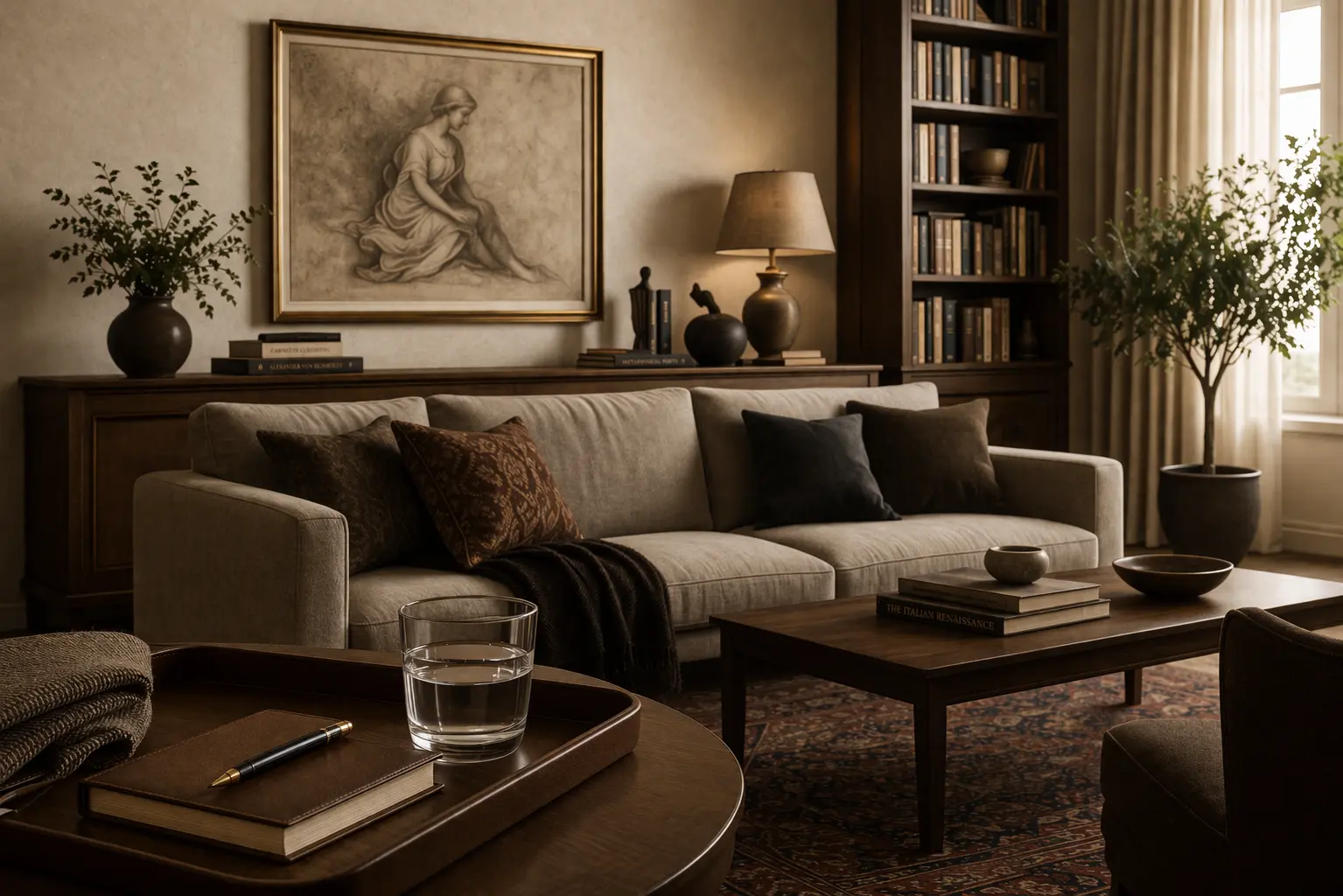
The environments we inhabit are not neutral. The spaces we occupy and the objects we live with actively shape how we think, feel, and orient ourselves in everyday life.
Over time, much of it becomes habitual and disappears from view. What steadies us, what distracts us, and what no longer belongs often goes unnoticed.
Stage One
focuses on your immediate surroundings and personal objects. It is complete in itself.
Its focus lies on physical environments and material realities rather than personal circumstances.
Stage Two extends the process into the broader living or working environment. It builds on the foundations established in Stage One. In some cases, it can also begin directly where sufficient context already exists.
A renewed awareness of your environment and the influences shaping everyday life.
A stable relationship with your environment that supports presence without constant effort.

A focused engagement that restores clarity through attention: moving beyond stylistic preference to observe how space, material presence, and personal objects shape orientation and daily experience.
A written reflection designed to slow perception and establish context. Not polished answers, but attention to what carries weight.
Guided by the Inquiry, we explore your environment and selected objects, noticing what grounds you, what distracts you, and what no longer belongs.
Stage One: € 398. Includes preparation, review, and the session.
The Inquiry marks the beginning of Stage One. It is a written reflection designed to establish context before we meet. Rather than providing answers, it invites you to notice what carries weight in your environment and why.
Take the time this deserves. Submission does not obligate you to proceed.
After submission, I read your Inquiry personally and respond within four business days. Your responses are confidential, read personally, and not processed by automated systems. They are retained only as long as necessary for our exchange.

Stage Two builds on the foundations established in Stage One. Where sufficient context already exists, Stage Two can also begin directly. The aim is to strengthen what already supports daily life and address what no longer fits.
This stage explores how spaces, objects, and their arrangement influence everyday life. It proceeds carefully, respecting context, scale, and what should remain unchanged.
There is no predefined scope. The direction emerges from the environment itself. What already supports daily life is strengthened. What no longer fits is addressed with care.
From € 598. Final scope and investment are clarified through conversation.
Stage Two may follow Stage One once orientation is established. Where sufficient context already exists, it may also be entered directly.
The conversation establishes the essentials: the space in question, its purpose, and what is currently asking for attention.
Because every environment is different, no predefined scope exists. The conversation determines the direction.